
From Farm to Global Markets: How Vihang Enterprises Ensures Purity and Standards in Sesame Seed Sourcing
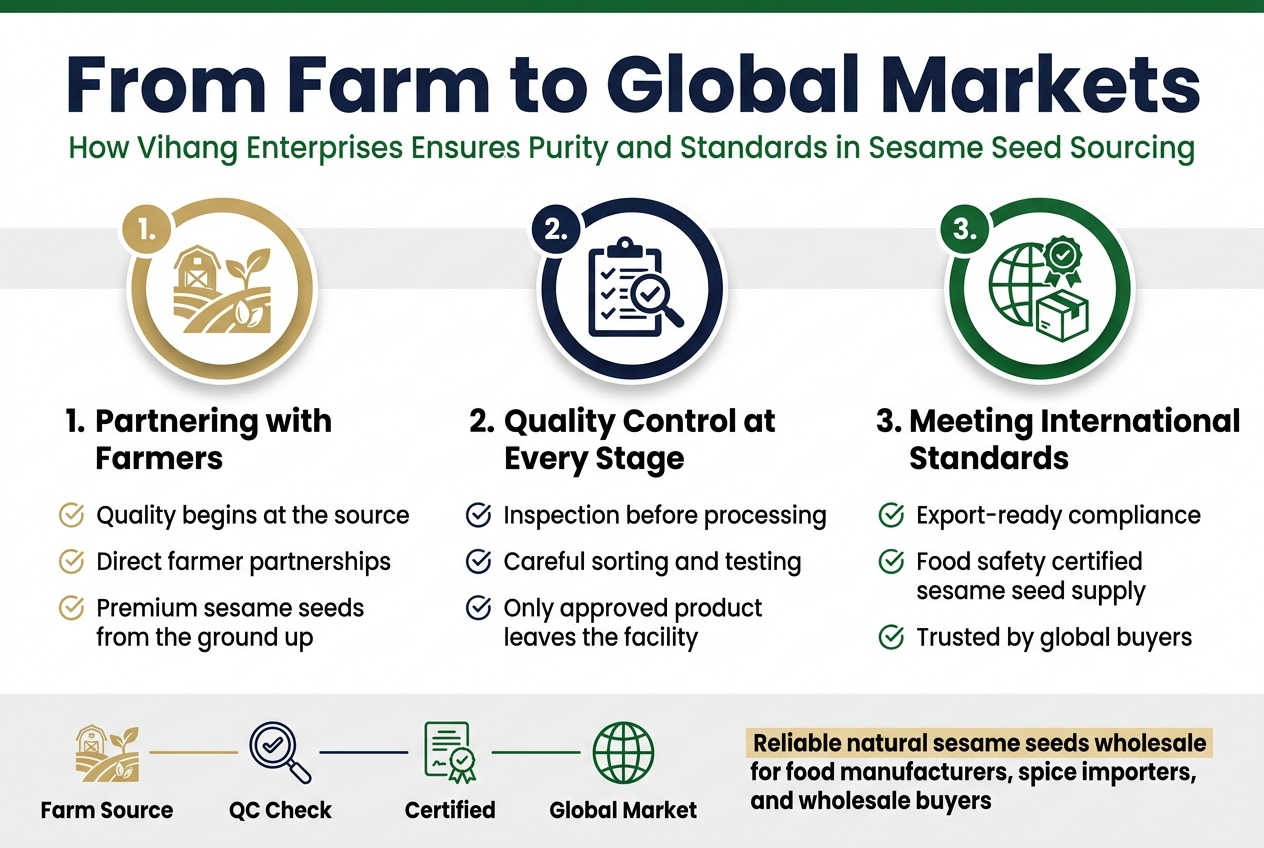
If you’re a food manufacturer, spice importer, or wholesale buyer trying to lock down a reliable source of premium sesame seeds, you already know the headache — inconsistent quality, unclear sourcing practices, and suppliers who talk big but deliver mediocre product.
This is exactly the gap Vihang Enterprises set out to close.
In this post, we’ll walk you through how Vihang built a farm-to-market sesame seed supply chain that actually holds up under pressure. You’ll get a clear look at how they partner with farmers to guarantee seed quality from the ground up, how their sesame seed quality control process works at every stage before the product leaves the facility, and how they meet international sesame seed standards that global buyers expect — no shortcuts, no guesswork.
Whether you’re sourcing natural sesame seeds wholesale for the first time or switching from a supplier who’s been letting you down, this breakdown gives you the full picture of what a trustworthy, food safety certified sesame seed exporter actually looks like in practice.
Let’s get into it.
The Journey Begins: Vihang Enterprises and Its Roots in Sesame Seed Sourcing
A Legacy Built on Agricultural Excellence
Vihang Enterprises didn’t appear overnight. The company grew from years of hands-on involvement in India’s agricultural landscape, where understanding the soil, the seasons, and the supply chain wasn’t a business strategy — it was survival. That ground-level experience shaped everything about how Vihang operates today.
From the very beginning, the focus was never just on trading sesame seeds. It was about building something more reliable — a sourcing ecosystem where quality wasn’t left to chance. That meant forging real relationships with farmers, learning the nuances of different growing regions, and developing a process that respected both the crop and the people behind it.
Over time, that approach earned the trust of buyers across multiple countries. When customers come to Vihang, they’re not just purchasing a commodity. They’re tapping into a system refined through years of agricultural experience, honest partnerships, and a refusal to cut corners.
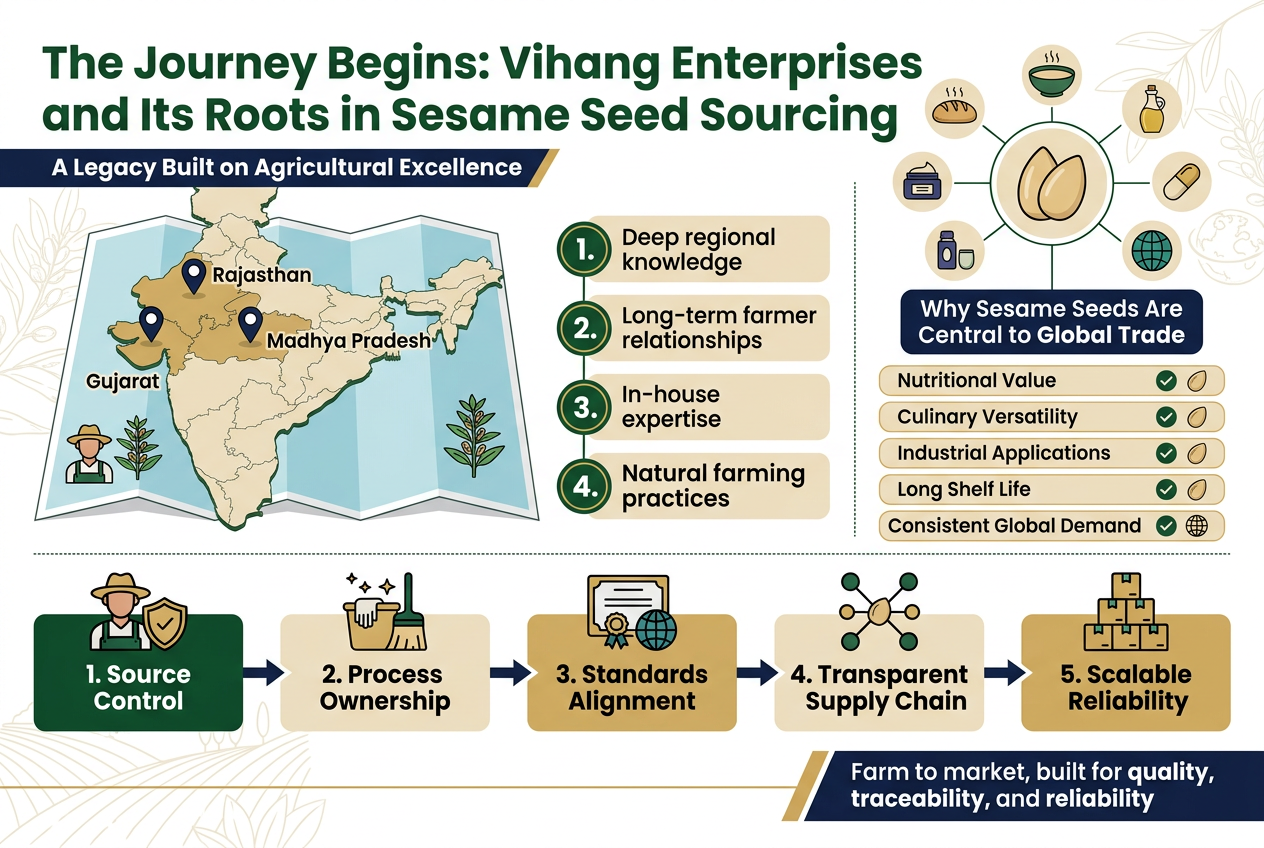
Key pillars that define Vihang’s agricultural legacy:
-
- Deep regional knowledge across India’s top sesame-growing belts, including Gujarat, Rajasthan, and Madhya Pradesh
-
- Long-term farmer relationships built on fair pricing and consistent engagement
-
- In-house expertise at every stage, from pre-harvest planning to final dispatch
-
- Commitment to natural farming practices that protect seed integrity and nutritional value
Why Sesame Seeds Are Central to Global Trade
Sesame seeds might seem like a small ingredient, but they carry enormous weight in global food and commodity markets. They show up everywhere — in bakery products, tahini pastes, confectionery, cosmetics, pharmaceuticals, and cooking oils. That kind of demand doesn’t slow down.
The global sesame seed trade runs into billions of dollars annually. Countries across Asia, Africa, the Middle East, North America, and Europe rely on consistent imports to fuel their food manufacturing and processing industries. For sesame seed sourcing to work at this scale, you need suppliers who understand international expectations — not just domestic ones.
Here’s a quick look at why sesame seeds hold such strategic importance in global trade:
| Factor | Why It Matters |
|---|---|
| Nutritional Value | High oil content, rich in lignans, protein, and antioxidants make sesame seeds attractive to health-focused markets |
| Culinary Versatility | Used across Asian, Middle Eastern, African, and Western cuisines |
| Industrial Applications | Sesame oil is used in pharmaceuticals and cosmetics, driving non-food demand |
| Long Shelf Life | Properly processed seeds store well, making them ideal for long-distance trade |
| Consistent Global Demand | Steady import requirements from Japan, China, South Korea, the USA, and the EU |
India sits at the center of this trade as one of the world’s leading sesame seed producing and exporting nations. For a company like Vihang, being rooted in India’s sesame-growing heartland means being positioned exactly where it matters most for premium sesame seeds export.
What sets the best suppliers apart in this market isn’t just volume — it’s the ability to deliver natural sesame seeds wholesale at a standard that consistently meets buyer expectations, shipment after shipment.
The Vision Behind Farm-to-Market Operations
The phrase “farm to market” gets used loosely in the agriculture business, but at Vihang Enterprises, it represents a specific operating philosophy. Every link in the chain — from where the seed is grown to how it reaches a buyer’s warehouse — is treated as equally important.
Most quality problems in sesame seed supply chains don’t happen during processing. They start much earlier, in poorly managed farms, through inconsistent harvesting practices, or during inadequate post-harvest handling. By the time those issues show up at the processing stage, damage has already been done. Vihang’s approach addresses this by moving quality control upstream — all the way back to the farm.
The farm-to-market vision rests on a few clear commitments:
1. Source Control
Working directly with vetted farmers rather than relying on multiple layers of middlemen. This keeps product traceability intact and ensures consistent quality from the very first step.
2. Process Ownership
Maintaining oversight of cleaning, grading, and processing instead of outsourcing critical stages. When something goes wrong, the team knows exactly where to look.
3. Standards Alignment
Aligning every operational step with international sesame seed standards so that buyers in Europe, Japan, or the United States receive a product that clears regulatory inspections without complications.
4. Transparent Supply Chain
Giving buyers the visibility they need to make informed sourcing decisions. In today’s global food trade, that kind of transparency is not a luxury — it’s a baseline requirement.
5. Scalable Reliability
Building processes that can scale without compromising quality, so whether a buyer needs a small trial shipment or large bulk sesame seed supplier quantities, the output remains consistent.
This vision isn’t about idealism. It’s about solving a real problem that bulk buyers and food manufacturers face every day — finding a sesame seed partner they can actually depend on across seasons, markets, and order sizes.
Partnering with the Right Farmers for Superior Quality
How Vihang Identifies and Selects Trusted Farm Partners
The quality of sesame seeds starts long before they reach any processing facility. It starts in the soil. That’s why Vihang Enterprises puts serious effort into identifying farm partners who meet a very specific set of criteria — not just for the seeds they produce, but for how they grow them.
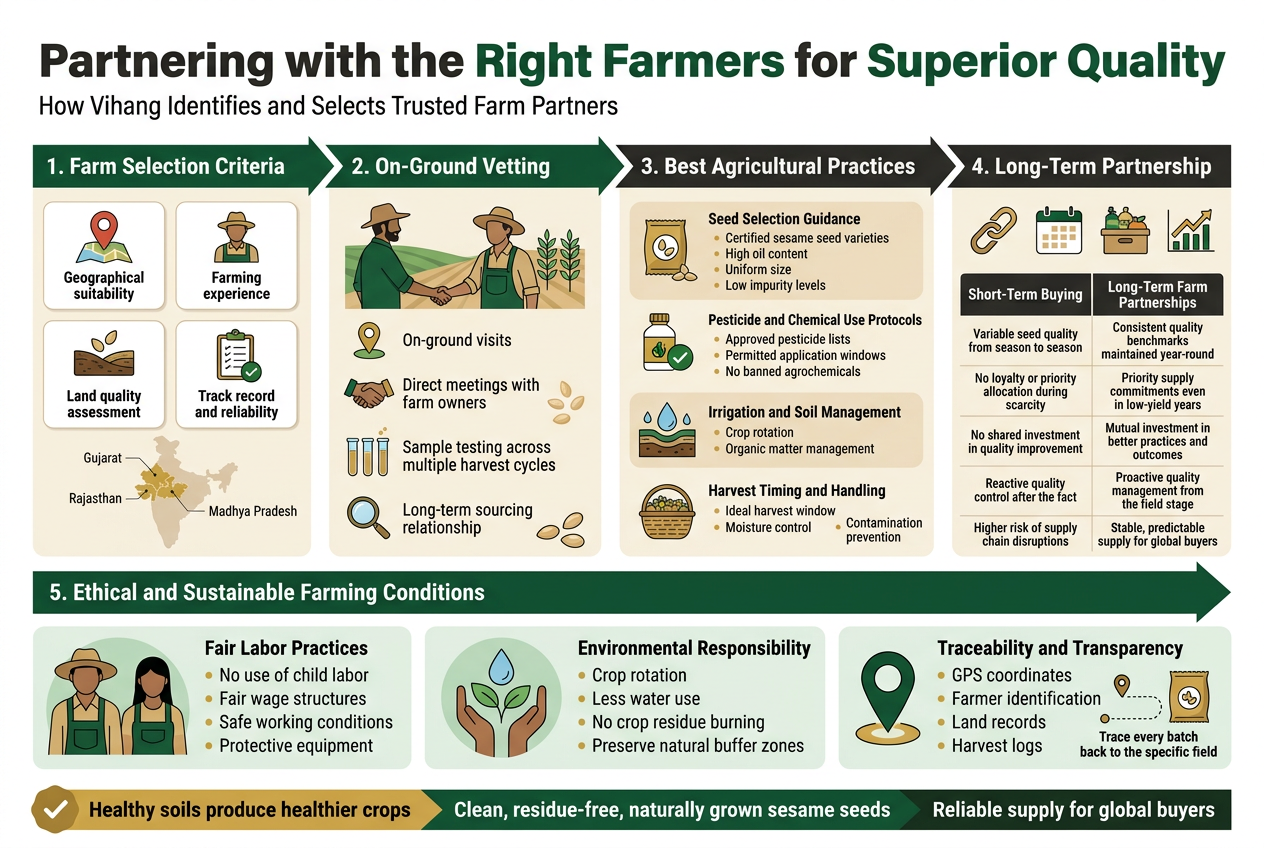
The selection process looks at several key factors:
-
- Geographical suitability — Farms located in regions with the right climate, soil composition, and rainfall patterns naturally yield higher-quality sesame seeds. Vihang targets agricultural zones in India that are historically known for producing premium sesame varieties, including Gujarat, Rajasthan, and Madhya Pradesh.
-
- Farming experience — Partners with multi-generational experience in sesame cultivation bring an instinctive understanding of the crop that newer farms simply can’t replicate overnight.
-
- Land quality assessment — Soil testing is carried out to check for heavy metal contamination, pesticide residue levels, and mineral content before any partnership is formalized.
-
- Track record and reliability — Previous yield data, harvest consistency, and any prior export-grade production history are all reviewed carefully.
Vihang doesn’t just sign up any farmer who has sesame fields. The team conducts on-ground visits, meets with farm owners directly, and runs sample testing from multiple harvest cycles before committing to a long-term sourcing relationship. This upfront investment in vetting is what keeps the sesame seed quality control standards consistently high across every shipment.
Supporting Farmers with Best Agricultural Practices
Selecting the right farmers is only half the work. Once a partnership is established, Vihang actively works alongside its farm partners to make sure cultivation practices align with international sesame seed standards.
This support comes in practical, hands-on ways:
Seed Selection Guidance
Vihang helps farmers choose certified sesame seed varieties that are known for higher oil content, uniform size, and low impurity levels — all traits that matter enormously to global buyers looking for natural sesame seeds wholesale or in bulk.
Pesticide and Chemical Use Protocols
One of the most critical areas in farm-to-market sesame seed production is chemical management. Vihang provides clear guidelines on:
-
- Approved pesticide lists that comply with EU, US FDA, and Japanese food safety standards
-
- Permitted application windows to allow for proper pre-harvest intervals
-
- Complete avoidance of banned agrochemicals that would flag during residue testing at the export stage
Irrigation and Soil Management
Overwatering or poor drainage can lead to aflatoxin contamination — a serious concern for food safety certified sesame seeds. Farmers are coached on irrigation schedules, crop rotation practices, and organic matter management to keep soil health in check.
Harvest Timing and Handling
Harvesting sesame at the right maturity stage directly affects seed color, moisture content, and shelf life. Vihang field representatives work with farmers to identify the ideal harvest window and supervise early-stage post-harvest handling to prevent contamination or moisture damage right at the source.
This level of involvement means fewer rejections, fewer quality failures, and a more reliable supply of premium sesame seeds for export — which benefits everyone in the chain.
Building Long-Term Relationships for Consistent Supply
Spot buying from random farms each season might seem like a flexible strategy, but it’s a recipe for inconsistency. Vihang takes a different approach by building multi-year relationships with its core group of farm partners.
Here’s why this matters for a bulk sesame seed supplier:
| Short-Term Buying | Long-Term Farm Partnerships |
|---|---|
| Variable seed quality from season to season | Consistent quality benchmarks maintained year-round |
| No loyalty or priority allocation during scarcity | Priority supply commitments even in low-yield years |
| No shared investment in quality improvement | Mutual investment in better practices and outcomes |
| Reactive quality control after the fact | Proactive quality management from the field stage |
| Higher risk of supply chain disruptions | Stable, predictable supply for global buyers |
Long-term farm partners also become better partners over time. They understand Vihang’s quality requirements inside out. They know which seed varieties work best, which harvesting methods pass muster, and what documentation is needed for export compliance. That shared knowledge builds efficiency across every harvest cycle.
Farmers also benefit from price stability, assured market access, and technical support — which means they’re genuinely motivated to maintain standards rather than cutting corners. That mutual investment is what makes the sesame seed sourcing relationship sustainable over the long run.
Ensuring Ethical and Sustainable Farming Conditions
Global buyers today — whether they’re food manufacturers, retailers, or distributors — are paying close attention to where their ingredients come from and how they’re produced. Ethical sourcing has moved from being a “nice to have” to a real purchasing criterion in the global sesame seed trade.
Vihang holds its farm partners to a clear set of ethical and environmental standards:
Fair Labor Practices
-
- No use of child labor at any stage of cultivation or harvesting
-
- Fair wage structures for farm workers that meet or exceed regional standards
-
- Safe working conditions during harvest season, including access to protective equipment when handling crops
Environmental Responsibility
-
- Encouraging crop rotation to maintain soil fertility and reduce dependence on synthetic inputs
-
- Discouraging excessive water use in drought-prone regions
-
- Minimizing burning of crop residue, which contributes to air pollution and soil degradation
-
- Supporting biodiversity by preserving natural buffer zones around farms where possible
Traceability and Transparency
Every farm partner in Vihang’s network is documented with GPS coordinates, farmer identification, land records, and harvest logs. This traceability chain is what makes it possible to trace any batch of sesame seeds right back to the specific field it came from — a feature that international buyers increasingly demand as part of their own compliance requirements.
Sustainable farming conditions also protect yield quality over time. Healthy soils produce healthier crops, and healthy crops produce the kind of clean, residue-free, naturally grown sesame seeds that pass rigorous international food safety inspections without rework or rejection.
Rigorous Quality Control at Every Stage of Sourcing
Field-Level Inspection and Seed Selection Criteria
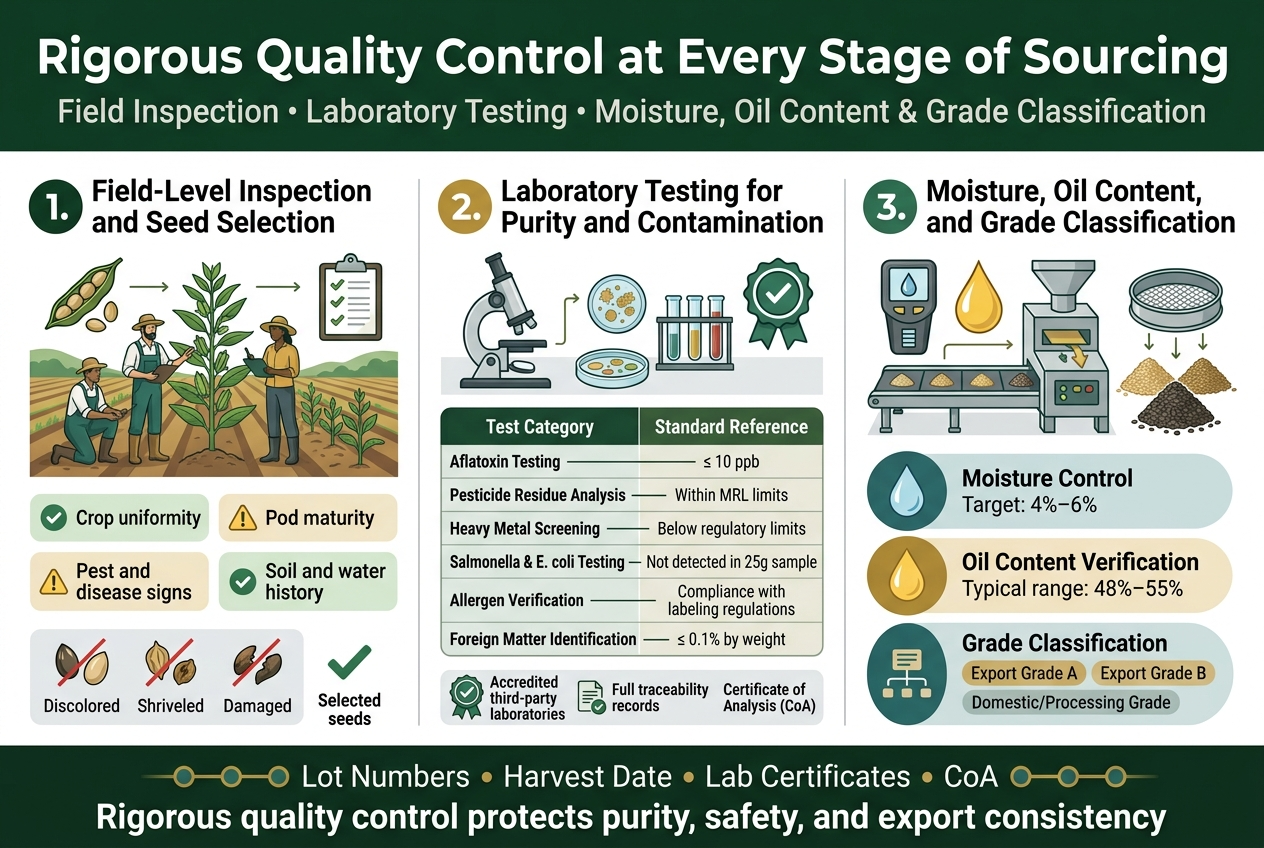
Every batch of premium sesame seeds that leaves a Vihang Enterprises facility starts its journey long before it reaches any processing unit. It starts right in the field, where trained agronomists and quality inspectors work directly with farming partners to assess crop health at multiple growth stages.
Here’s what field-level inspection actually looks at:
-
- Crop uniformity – Are the plants growing evenly across the field? Irregular growth patterns often signal inconsistent soil conditions or pest pressure, both of which can affect seed quality.
-
- Pod maturity – Sesame seeds harvested too early carry higher moisture levels and underdeveloped oil content. Inspectors check for the right visual cues and dryness indicators before giving the green light for harvest.
-
- Pest and disease signs – Any visible signs of fungal disease, aphid damage, or weed contamination in the crop get flagged immediately. Affected lots are either treated before harvest or disqualified entirely.
-
- Soil and water history – Fields are evaluated based on irrigation water quality, prior crop rotation, and chemical input records to rule out contamination risks before sowing even begins.
Seed selection criteria are equally strict. Once harvested, seeds go through a preliminary visual check and manual sorting to remove discolored, shriveled, or damaged seeds before the lot even enters the supply chain pipeline.
This farm-level vigilance is what separates responsible sesame seed sourcing from ordinary commodity procurement.
Laboratory Testing for Purity and Contamination-Free Standards
Once sesame seeds clear field inspection and arrive at Vihang’s processing facilities, they undergo a battery of lab tests designed to verify what the naked eye can’t detect. This is where sesame seed quality control gets technical — and where international buyers can feel confident about what they’re actually receiving.
Key Tests Conducted at the Laboratory Level
| Test Category | What It Detects | Acceptable Threshold (Standard Reference) |
|---|---|---|
| Aflatoxin Testing | Fungal toxin contamination | ≤ 10 ppb (EU/FDA standard) |
| Pesticide Residue Analysis | Chemical residues from farming inputs | Within MRL limits (Codex Alimentarius) |
| Heavy Metal Screening | Lead, cadmium, arsenic, mercury | Below regulatory limits per destination market |
| Salmonella & E. coli Testing | Microbial contamination | Not detected in 25g sample |
| Allergen Verification | Cross-contamination from processing | Compliance with labeling regulations |
| Foreign Matter Identification | Sand, husk, plant debris, stones | ≤ 0.1% by weight |
These tests aren’t just checkboxes. They align with the import requirements of the European Union, the United States FDA, Japan’s Food Safety Commission, and other stringent regulatory bodies that govern global sesame seed trade.
Seeds bound for food safety certified sesame seed markets face even stricter scrutiny. Vihang works with accredited third-party laboratories to run independent verification — giving overseas buyers an additional layer of assurance that test results aren’t self-reported.
For natural sesame seeds wholesale buyers who need consistent documentation, Vihang provides full traceability records, including:
-
- Lot numbers linked to specific farm clusters
-
- Date of harvest and processing
-
- Lab test certificates with reference numbers
-
- Certificate of Analysis (CoA) for each shipment
This kind of transparency is exactly what food importers, manufacturers, and retailers are looking for when they vet a bulk sesame seed supplier for long-term partnerships.
Moisture, Oil Content, and Grade Classification Processes
Two of the most commercially critical parameters for sesame seeds — moisture content and oil content — directly determine shelf life, processing efficiency, and market pricing. Getting these right isn’t optional; it’s the backbone of any credible sesame seed export operation.
Moisture Control
Sesame seeds with moisture content above 6% are vulnerable to mold growth, aflatoxin development, and rapid quality degradation during shipping. Vihang targets a moisture level between 4% and 6% for export-grade lots, measured using calibrated grain moisture meters and confirmed through oven-drying methods in the lab.
Batches that test above the acceptable range go through controlled drying processes before they advance further — never passed along to cut corners on timelines.
Oil Content Verification
Sesame seeds are prized globally for their high oil yield, which typically ranges between 48% and 55% in quality varieties. Seeds with low oil content reduce extraction efficiency for buyers in the edible oil processing sector and also indicate under-maturity or poor agronomic conditions.
Oil content is assessed using solvent extraction methods, and only lots meeting the minimum threshold for the buyer’s intended end-use move forward in the supply chain.
Grade Classification
Not all sesame seeds are the same, even within a single harvest. Vihang classifies seeds into distinct grades based on multiple physical and chemical attributes:
-
- Export Grade A – Highest purity, uniform color, minimum foreign matter, ideal for direct food applications like baking, confectionery, and tahini production
-
- Export Grade B – Slight variation in uniformity, suitable for oil extraction and industrial food processing
-
- Domestic/Processing Grade – Lower purity threshold, used for animal feed or secondary processing where aesthetic standards are less critical
Grade classification happens through a combination of optical sorting machines, sieve grading equipment, and manual spot checks. This layered approach ensures that what gets labeled as premium sesame seeds export quality actually lives up to that claim — batch after batch, shipment after shipment.
Meeting International Food Safety and Export Standards
Compliance with Global Certifications and Regulatory Requirements
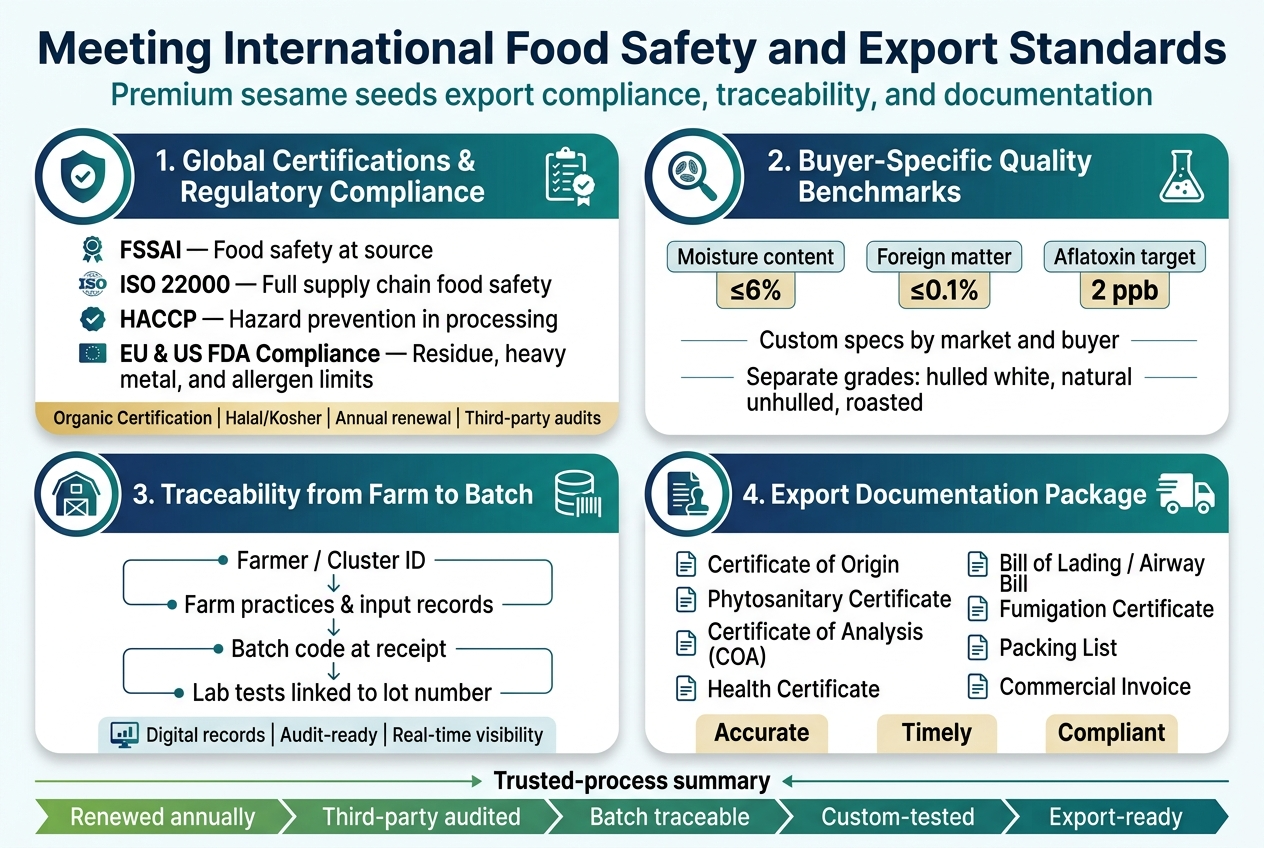
When it comes to premium sesame seeds export, having the right certifications is not just a checkbox exercise — it’s the foundation of trust with international buyers. Vihang Enterprises actively maintains and pursues certifications that align with the world’s most demanding food safety frameworks.
Key certifications and compliance standards include:
-
- FSSAI (Food Safety and Standards Authority of India) — ensuring domestic production meets baseline food safety requirements before products ever reach an export container
-
- ISO 22000 — a globally recognized food safety management system that covers the entire supply chain, from sesame seed sourcing right through to dispatch
-
- HACCP (Hazard Analysis and Critical Control Points) — a systematic preventive approach that identifies potential physical, chemical, and biological hazards at each stage of processing
-
- EU and US FDA Import Compliance — sesame seeds entering Europe or North America must meet strict pesticide residue limits, heavy metal thresholds, and allergen labeling requirements; Vihang’s processes are built specifically to clear these thresholds consistently
-
- Organic Certification (where applicable) — for buyers requiring certified organic natural sesame seeds wholesale supply, third-party organic audits are conducted to verify non-GMO, pesticide-free cultivation practices
| Certification | Relevant Market | Primary Focus |
|---|---|---|
| FSSAI | India (base compliance) | Food safety at source |
| ISO 22000 | Global | Full supply chain food safety |
| HACCP | EU, USA, Japan, Middle East | Hazard prevention in processing |
| EU Organic | European Union | Organic integrity and non-GMO |
| US FDA Compliance | United States | Pesticide limits, allergens |
| Halal/Kosher | Middle East, select global | Religious dietary standards |
Staying compliant with these international sesame seed standards isn’t a one-time effort. Vihang Enterprises treats certifications as living commitments — renewing them annually, inviting third-party auditors onto the facility floor, and proactively adjusting processes whenever regulatory bodies update their guidelines.
Aligning with Buyer-Specific Quality Benchmarks
Every international buyer comes with their own set of expectations, and experienced exporters know that a one-size-fits-all approach simply doesn’t work in global sesame seed trade. A Japanese confectionery manufacturer has different tolerance levels for moisture content compared to a Middle Eastern tahini producer. A European health food brand has different visual grade requirements than a large-scale food processing company in the United States.
Vihang Enterprises handles this by building buyer-specific quality profiles into its sourcing and processing workflow from the very beginning. Here’s how this plays out practically:
-
- Pre-shipment specification sheets are exchanged with buyers before any order is processed, clearly outlining:
-
- Moisture content tolerance (typically ≤6% for most export markets)
-
- Foreign matter limits (often ≤0.1% for premium grades)
-
- Oil content requirements (ranging between 48–52% depending on end use)
-
- Color uniformity standards (critical for sesame used in visible food applications)
-
- Seed size and uniformity grades
-
- Pre-shipment specification sheets are exchanged with buyers before any order is processed, clearly outlining:
-
- Custom testing protocols are set up for buyers who have stricter requirements than standard export norms. If a buyer specifies that aflatoxin levels must not exceed 2 ppb rather than the standard 10 ppb limit, that benchmark becomes the internal target — not just the bare minimum.
-
- Grade segmentation allows Vihang to supply different quality tiers to different buyers without cross-contamination of grades. Hulled white sesame, natural unhulled sesame, and roasted sesame variants are each processed and stored separately.
This buyer-first approach builds long-term relationships. When buyers know that their specific requirements are being treated as operational priorities and not just afterthoughts, they come back — and they refer others.
Traceability Systems That Build Buyer Confidence
In today’s food supply chain environment, buyers don’t just want good sesame seeds — they want to know exactly where those seeds came from, how they were handled, and who touched them along the way. Traceability has moved from being a “nice to have” to a non-negotiable in food safety certified sesame seeds supply.
Vihang Enterprises has built traceability into its DNA across several layers:
Farm-Level Traceability
-
- Each farmer or farming cluster supplying sesame is registered with a unique supplier ID
-
- Farm location, cultivation practices, and input usage (fertilizers, pesticides) are documented before procurement begins
-
- This makes it possible to trace any batch of sesame seeds back to the specific farm or region it was grown in
Batch Coding and Lot Management
-
- Every incoming lot of raw sesame is assigned a batch code at the point of receipt
-
- This code follows the product through cleaning, processing, quality testing, and packaging
-
- If an issue is detected at any stage, the batch can be isolated and investigated without disrupting other inventory
Lab Testing Records
-
- Each batch undergoes testing at a certified in-house or third-party laboratory
-
- Test results — covering moisture, purity, pesticide residues, aflatoxin, and microbiological parameters — are linked to the corresponding batch code
-
- Buyers can request these records as part of their due diligence process
Digital Record-Keeping
-
- Moving away from paper-only documentation, Vihang is integrating digital systems that allow for faster retrieval, audit-ready reporting, and real-time visibility for key account buyers
This level of traceability doesn’t just protect buyers — it also protects Vihang Enterprises itself. If a question ever arises about a shipment, the data exists to provide a clear, defensible answer quickly.
How Documentation Supports Seamless Global Trade
Strong documentation is the unsung backbone of reliable bulk sesame seed supplier operations. Poor paperwork — even with a perfect product — can lead to customs holds, delayed clearances, port rejections, and damaged buyer relationships. Vihang Enterprises understands this deeply and treats documentation as seriously as physical quality control.
A standard export shipment from Vihang comes with a comprehensive documentation package that includes:
-
- Certificate of Origin — legally confirming the sesame seeds are of Indian origin, which matters for tariff preferential agreements under various bilateral trade frameworks
-
- Phytosanitary Certificate — issued by the Plant Quarantine Authority, confirming that the consignment is free from pests and plant diseases
-
- Certificate of Analysis (COA) — detailed lab report covering physical, chemical, and microbiological parameters tested for that specific batch
-
- Health Certificate — required by several importing countries as proof that the product meets their human consumption standards
-
- Fumigation Certificate — mandatory for many markets to confirm that stored grain pests have been eliminated prior to shipment
-
- Bill of Lading / Airway Bill — shipping document that acts as the title of goods
-
- Packing List — detailed breakdown of how the consignment is packed, including number of bags, individual weights, and total gross/net weight
-
- Commercial Invoice — covering pricing, HS codes, and buyer/seller details
Beyond just having the right documents, Vihang Enterprises ensures that all paperwork is:
-
- Accurate — every figure, certificate number, and description matches the physical shipment exactly
-
- Timely — documents are prepared and dispatched ahead of the shipment so buyers can prepare for customs clearance on their end
-
- Compliant — format and content requirements vary by destination country, and Vihang’s export team stays updated on country-specific documentation rules
For buyers who work with sesame seed quality control as a regulatory requirement in their own markets, having clean, complete documentation from the supplier dramatically reduces friction at the import stage. It signals professionalism, reliability, and a serious commitment to the buyer’s operational success — all of which are the reasons that global buyers keep coming back to trusted sources for their farm to market sesame seeds supply needs.
Processing and Packaging That Preserves Seed Integrity
State-of-the-Art Cleaning and Sortex Technology
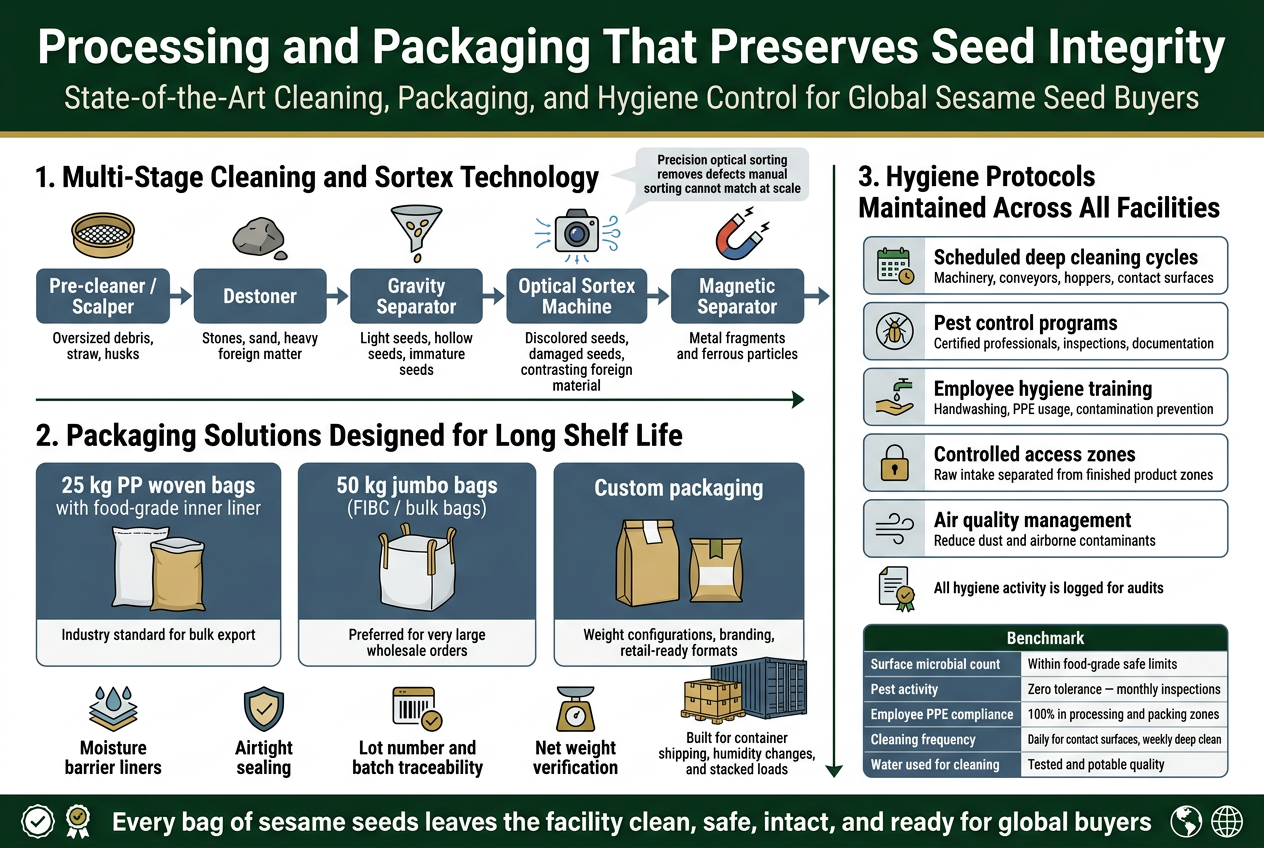
Getting sesame seeds from the farm to a global buyer’s facility without compromising their quality takes serious investment in the right technology. At Vihang Enterprises, sesame seed processing starts with multi-stage cleaning systems that remove field debris, dust, stones, husks, and any foreign matter that sneaks in during harvesting. This isn’t a quick rinse-and-move-on situation — every batch goes through a deliberate, layered cleaning sequence.
The real game-changer in the processing workflow is Sortex technology — optical sorting machines that use high-resolution cameras and air-jet rejection systems to identify and remove discolored seeds, shriveled seeds, and any material that doesn’t meet visual quality benchmarks. This level of precision is something manual sorting simply cannot match at scale.
Here’s a quick look at what the multi-stage processing flow covers:
| Processing Stage | What It Removes |
|---|---|
| Pre-cleaner / Scalper | Oversized debris, straw, husks |
| Destoner | Stones, sand, heavy foreign matter |
| Gravity Separator | Light seeds, hollow seeds, immature seeds |
| Optical Sortex Machine | Discolored seeds, damaged seeds, contrasting foreign material |
| Magnetic Separator | Metal fragments and ferrous particles |
Each step feeds into the next, creating a processing chain where the seed integrity is protected at every checkpoint. The result is a final product that consistently hits the purity standards demanded by international food safety certified sesame seed buyers across Europe, Asia, and North America.
Packaging Solutions Designed for Long Shelf Life
Even the cleanest, highest-quality sesame seeds can lose their value fast if packaging isn’t done right. Moisture absorption, oxidation, and cross-contamination during transit are real threats — especially when you’re talking about bulk sesame seed shipments traveling across oceans for weeks at a time.
Vihang Enterprises uses packaging materials and methods specifically chosen to protect natural sesame seeds wholesale orders from the moment they leave the facility to the moment they’re opened by the end buyer.
Standard Packaging Options:
-
- 25 kg PP woven bags with food-grade inner liner — the industry standard for bulk sesame seed export, offering durability against physical damage while the inner liner keeps moisture out
-
- 50 kg jumbo bags (FIBC / bulk bags) — preferred for very large wholesale orders where warehouse storage is well-controlled
-
- Custom packaging — for buyers who need specific weight configurations, branding, or retail-ready formats
Key features built into the packaging process:
-
- Moisture barrier liners that significantly extend shelf life under varying climate conditions
-
- Airtight sealing immediately after filling to minimize oxygen exposure
-
- Lot number and batch traceability labeling on every package for full supply chain accountability
-
- Net weight verification at packing stations to ensure compliance with buyer specifications
For premium sesame seeds export, the packaging is also designed to hold up under the stress of container shipping — stacked pallets, shifting loads, humidity fluctuations in the shipping container — without compromising the seed quality inside.
Hygiene Protocols Maintained Across All Facilities
Clean technology and good packaging mean nothing if the facility itself isn’t held to strict hygiene standards. Sesame seed processing and packaging facilities at Vihang Enterprises operate under documented hygiene protocols that align with international food safety expectations — the kind buyers from regulated markets absolutely look for before signing supply agreements.
What daily hygiene management looks like on the ground:
-
- Scheduled deep cleaning cycles for all processing machinery, conveyors, hoppers, and contact surfaces
-
- Pest control programs managed by certified professionals, with regular inspections and documentation
-
- Employee hygiene training covering handwashing, PPE usage (gloves, hairnets, masks), and contamination prevention behavior
-
- Controlled access zones that separate raw material intake areas from finished product zones, preventing cross-contamination
-
- Air quality management in packaging rooms to reduce dust and airborne contaminants
-
- Water quality checks for any water used in cleaning processes
All hygiene activity is logged, and records are maintained to support audits by third-party certifying bodies. This kind of documentation discipline is what separates a serious bulk sesame seed supplier from one that only talks about quality without being able to back it up.
Facility hygiene benchmarks Vihang targets:
| Hygiene Parameter | Standard Maintained |
|---|---|
| Surface microbial count | Within food-grade safe limits |
| Pest activity | Zero tolerance — monthly inspections |
| Employee PPE compliance | 100% in processing and packing zones |
| Cleaning frequency | Daily for contact surfaces, weekly deep clean |
| Water used for cleaning | Tested and potable quality |
The goal is simple — every bag of sesame seeds that leaves the facility should be as clean, safe, and intact as the quality control team intended it to be. When global buyers talk about trusting a sesame seed sourcing partner, this level of behind-the-scenes discipline is exactly what earns that trust.
Delivering Value to Global Buyers Through Reliable Supply Chains
Efficient Logistics and On-Time Export Capabilities
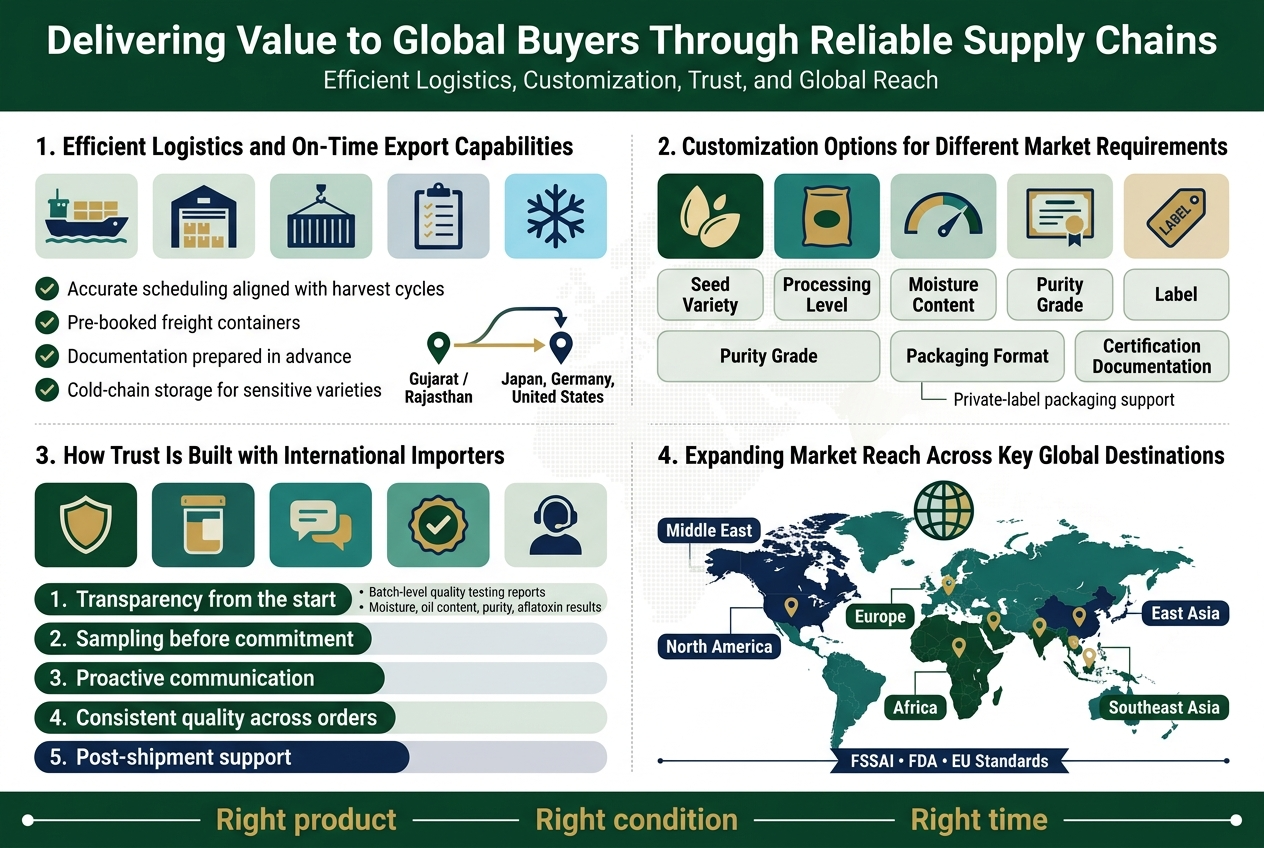
Getting sesame seeds from a farm in Gujarat or Rajasthan to a food manufacturer in Japan, Germany, or the United States is not a simple task. It takes precise coordination across multiple touchpoints — and Vihang Enterprises has built its entire logistics framework around making this process as smooth and predictable as possible.
Every shipment begins with careful pre-export planning. This includes:
-
- Accurate scheduling aligned with harvest cycles to avoid delays in availability
-
- Pre-booking of freight containers to prevent last-minute logistics gaps
-
- Documentation preparation well in advance, covering phytosanitary certificates, certificates of origin, quality analysis reports, and food safety compliance paperwork
-
- Cold-chain or temperature-controlled storage options where required, especially for natural and organic sesame seed varieties headed to sensitive markets
Vihang works closely with licensed customs brokers and freight forwarders who specialize in agricultural commodities. This means fewer surprises at ports, faster clearance, and shipments that consistently arrive on schedule.
For buyers who operate on tight manufacturing timelines, reliability is not a luxury — it’s a baseline expectation. Whether the destination is Rotterdam, Osaka, Dubai, or New York, the commitment remains the same: the right product, in the right condition, at the right time.
Customization Options for Different Market Requirements
No two markets are the same. A sesame seed buyer in South Korea has different needs than one in Italy or Saudi Arabia. Vihang Enterprises understands this reality deeply and offers a flexible approach to product customization that goes well beyond simply choosing between hulled and natural sesame seeds.
Here’s a quick look at the types of customization available:
| Customization Option | Details |
|---|---|
| Seed Variety | White sesame, black sesame, mixed varieties based on buyer preference |
| Processing Level | Raw/natural, hulled, roasted, sorted by size |
| Moisture Content | Adjusted based on destination climate and storage requirements |
| Purity Grade | Customized to meet specific market purity thresholds (99%, 99.5%, 99.98%) |
| Packaging Format | 25 kg PP bags, 50 kg jute bags, vacuum-sealed retail packs, or private-label options |
| Certification Documentation | Organic, non-GMO, kosher, halal, FSSC 22000, and more |
Many global buyers — especially those in the bulk sesame seed supplier supply chain — need products that fit directly into their own branding or processing workflows. Vihang makes this possible by offering private-label packaging support, where the buyer’s brand name and specifications are printed directly on bags without any additional sourcing or repackaging burden on the buyer’s end.
This kind of flexibility shortens lead times and eliminates the need for buyers to manage multiple vendors for different markets.
How Vihang Builds Trust with International Importers
Trust in the global sesame seed trade is built slowly, through repeated actions that consistently match promises. For Vihang Enterprises, trust is not just a value — it’s a business strategy.
Here’s how that trust gets built at every stage of the buyer relationship:
Transparency from the start
Vihang shares detailed product specifications, including batch-level quality testing reports, before any order is confirmed. Buyers know exactly what they are getting — moisture level, oil content, purity percentage, aflatoxin test results — before the first container is loaded.
Sampling before commitment
International buyers are encouraged to request pre-shipment samples. This is standard practice, and Vihang actively supports it because the product speaks for itself. Consistent samples that match delivered goods are one of the strongest trust-builders in any trade relationship.
Proactive communication
Buyers receive regular updates throughout the shipment process. From production updates to shipping notifications and real-time tracking details, there are no black holes in the communication process. If something changes — weather delays at port, a minor documentation revision — buyers are informed immediately, not after the fact.
Consistent quality across orders
One-time quality is impressive. Consistent quality across 10, 20, or 50 orders is what builds lasting business relationships. Vihang’s quality control systems are designed to deliver the same standard every single time, whether it’s the first shipment or the fiftieth.
Post-shipment support
After the goods arrive, Vihang remains accessible. If a buyer encounters an issue — whether it’s a documentation discrepancy or a product question — there’s a dedicated team ready to respond quickly.
Expanding Market Reach Across Key Global Destinations
Vihang Enterprises actively exports premium sesame seeds to markets across multiple continents, serving buyers with diverse needs in food manufacturing, retail packaging, and industrial processing.
Key export destinations include:
-
 Middle East — A high-volume market for natural and hulled sesame seeds, especially for tahini production and bakery applications
-
 East Asia (Japan, South Korea, China) — Extremely quality-sensitive markets requiring strict purity levels and consistent seed appearance
-
 North America (USA, Canada) — Strong demand for food safety certified sesame seeds, particularly organic and non-GMO varieties
-
- Europe (Germany, Netherlands, France, UK) — Buyers here require full traceability, allergen compliance documentation, and EU food safety standards
-
- Africa — Growing demand for natural sesame seeds wholesale supply, especially for re-processing and local distribution
-
- Southeast Asia — Rising demand for roasted and processed sesame seeds in snack and sauce manufacturing sectors
Each of these markets has specific regulations, labeling requirements, and quality benchmarks. Vihang’s export team stays current on regulatory updates across all key regions — including FSSAI guidelines in India, FDA requirements in the US, and EU pesticide residue standards — so buyers never have to worry about compliance surprises.
The expansion into new markets is not random. It is driven by buyer demand, market research, and careful assessment of where farm to market sesame seeds sourced at Vihang’s quality level can genuinely meet a gap. This deliberate approach has helped Vihang build a diverse but stable global buyer base rather than chasing volume at the expense of relationships.
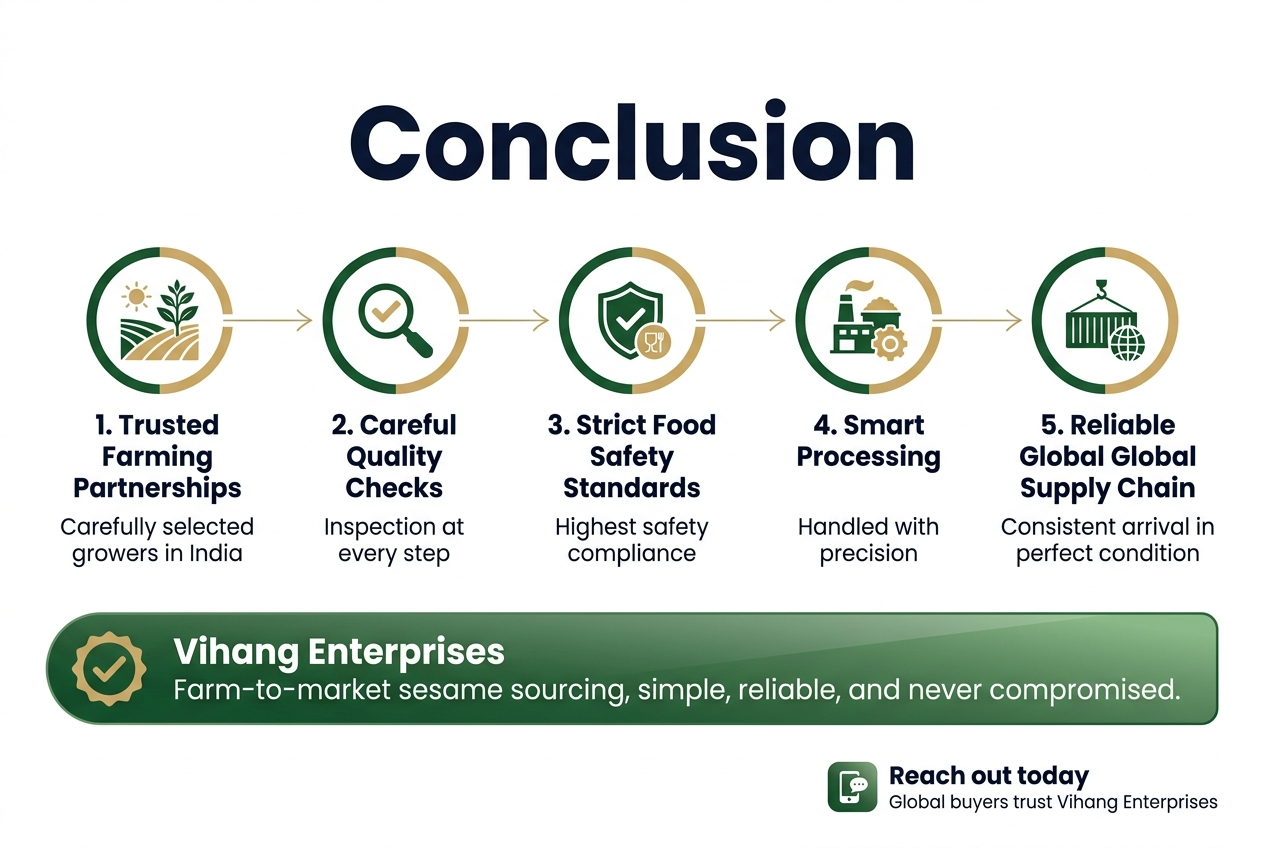
Getting sesame seeds from a farm in India to a buyer halfway across the world is no small feat. It takes the right farming partnerships, careful quality checks at every step, strict food safety standards, smart processing, and a supply chain that buyers can actually count on. That is exactly what Vihang Enterprises has built — a sourcing process where nothing is left to chance and quality is never compromised.
If you are a global buyer looking for a sesame seed supplier you can trust, the difference lies in the details — who grows the seeds, how they are handled, and how consistently they arrive in perfect condition. Vihang Enterprises brings all of that together, making farm-to-market sourcing simple, reliable, and held to the highest standards. Reach out today and see firsthand why buyers around the world keep coming back.